Australia Has Now Installed 100 Community Batteries. Here’s Why That Matters Even If You Don’t Own One.
Australia has now installed its 100th community battery under the Australian Renewable Energy Agency’s Community Batteries Funding Initiative. That is a small number compared with the hundreds of thousands of batteries being installed in homes, but it marks an important shift in the way rooftop solar is starting to work.
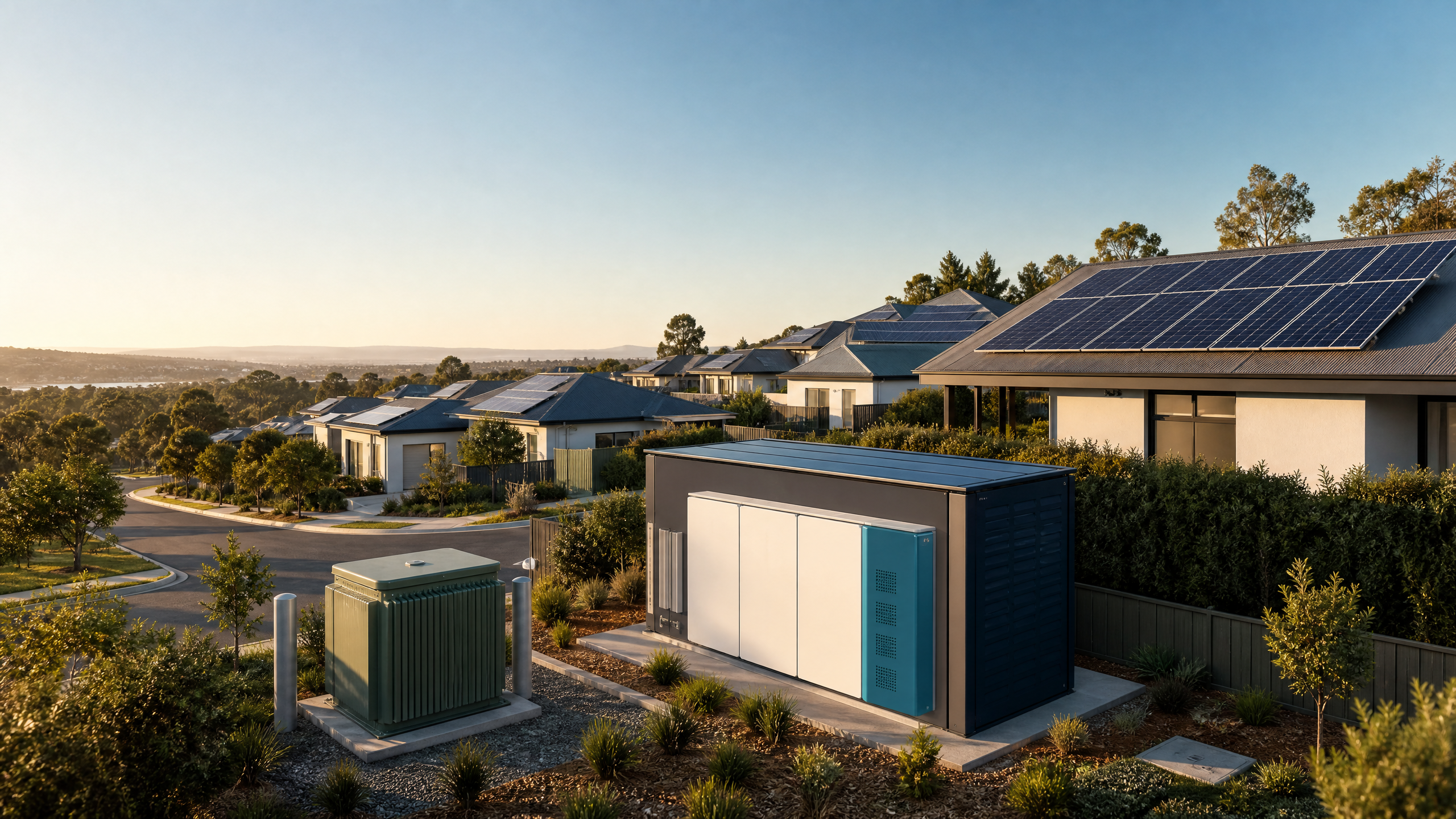
The first phase of the solar boom was simple: put panels on individual roofs and let households use what they could.
The next phase is harder. Australia needs a way to store and use more of the surplus solar arriving in the middle of the day without requiring every household to buy, maintain and operate a battery in its own garage.
That is what community batteries are trying to solve.
But before we go further, one important caveat: a community battery is not a free battery for every household living nearby. It does not automatically reduce every neighbour’s bill, and it does not replace a home battery for someone who wants backup power or direct control of their own energy.
Its benefits depend on the project, the network, the retailer arrangements, the tariff and who is eligible to participate.
What happened this week
On 2 September, ARENA confirmed the installation of the 100th community battery supported through its Community Batteries Funding Initiative. It also announced $23.2 million for three new projects that will deploy a further 47 batteries: 14 across regional South Australia and New South Wales, 21 across Sydney, the Central Coast and Hunter regions, and 12 integrated with embedded solar networks in Newcastle.
The milestone sits inside the Federal Government’s broader Community Batteries for Household Solar program, which is intended to install 400 shared batteries across Australia. The Department says the program is designed to store excess solar, support more rooftop-solar uptake, ease local grid pressure and enable households that cannot install their own panels to share in renewable-energy benefits.
That last point matters. A rooftop-solar system is a powerful asset, but it is not available to everyone. Renters, apartment residents, people with shaded roofs, and households without the upfront capital or suitable switchboard space can be left out of the home-battery story.
A community battery is one attempt to widen the circle.
What is a community battery?
A community battery is a larger shared battery connected to a local electricity network or embedded network. Instead of sitting behind one household’s meter, it can absorb some of the surplus solar from a neighbourhood during the day and make stored energy available later, when electricity demand is higher.
In principle, this can do three useful things at once: make better use of local solar, relieve pressure on the local network, and create a way for more customers to access storage-related benefits.
But community storage is not the same thing as a home battery or a virtual power plant.
Energy asset | Where it sits | Who owns or controls it | What to remember |
Home battery | At your home, behind your meter | Usually you, subject to your electricity plan and any VPP agreement | It can increase self-consumption and may provide backup if the system is designed for it. |
Community battery | On the local distribution network or in an embedded network | A network, council, retailer, community group or another project owner | Benefits, eligibility and tariffs are project-specific. Living nearby does not automatically mean you receive a bill credit. |
Virtual power plant (VPP) | Many customers’ own batteries, connected digitally | You own the battery; the provider may gain agreed dispatch rights | Read the contract carefully: payments, access to capacity and dispatch times vary. |
The central difference is ownership and access.
A home battery is your own energy asset. A VPP coordinates privately owned batteries through agreements. A community battery is shared infrastructure, and the way customers receive value depends on the business model around it.
Why now?
The headline number from the prior week gives the context.
The Clean Energy Regulator reported on 28 August that the June quarter was a record for both small-scale solar and household batteries. More than 111,000 batteries with 3.6 GWh of storage capacity were approved under the Cheaper Home Batteries Program in the quarter. Small-scale solar installations also exceeded 1 GW for the first time in a quarter.
Those figures are not new this week, but they explain why local storage has become urgent.
Solar produces most strongly in the middle of the day. Household demand is often lower then, especially when people are out. As more roofs produce at the same time, local networks need ways to manage voltage, exports and the difference between a sunny afternoon and an evening peak.
A shared battery is not the only answer. Home batteries, flexible electricity tariffs, smart EV charging, virtual power plants, better network planning and more commercial solar all matter.
But community batteries can be useful where a home battery is not practical, where the local network is constrained, or where a local energy plan can share benefits more broadly.
What should households realistically expect?
The promise is attractive: your suburb’s surplus solar is stored nearby and used later. But the customer experience is not yet standardised across Australia.
One project might offer a particular local tariff. Another could help a network defer an upgrade while producing benefits through a retailer partnership. Another might support an apartment or embedded network. Some projects may initially exist mainly to test technology, operations and customer models.
That is not a failure. It is precisely why ARENA says the program is gathering real-world evidence on battery performance, costs, customer benefits, business models and grid impacts.
The sensible consumer position is interest, not assumption.
If a community-battery offer comes to your area, ask the same questions you would ask about any energy offer:
-
Who is eligible? Is it limited to certain postcodes, retailers, tariffs, solar owners or housing types?
-
How does the benefit work? Is it a lower electricity rate, bill credit, export arrangement, membership fee or something else?
-
What is the contract term? Can the price change, and what happens if you move house or change retailer?
-
Do I need solar, a smart meter or a particular retailer? Do not assume the answer is yes—or no.
-
What data will be used? Understand how your consumption, export and meter data are handled.
The right question is not “Is there a community battery near me?” It is “Does the particular offer improve my energy position, on terms I understand?”
The other battery news: NSW turns to businesses
There was a second storage development this week, aimed at a different part of the market.
From 1 September, eligible NSW businesses can access a battery-installation discount under the Peak Demand Reduction Scheme. The state says the indicative discount is about 30–40% when a battery is installed with new or additional solar capacity, and about 20–30% for a battery-only installation. Actual discounts vary by project, equipment, site and installer. Eligible systems range from 20 kWh to 30 MWh.
This is not a household offer. But it signals the same policy direction: batteries are being valued not only for storing a site’s own solar, but for reducing stress on the grid at peak times.
Schools, warehouses, farms, retailers and factories often use significant energy during the day. Adding solar and storage at those sites can help them control costs while easing demand on the broader system.
System Health Diagnostic Corner: find your NMI before you need it
This week’s task takes two minutes.
Find your National Metering Identifier, or NMI, on your electricity bill. It is the unique number linked to your property’s electricity connection. Keep a copy with your solar paperwork, monitoring login, inverter model and warranty documents.
Why bother?
If you ever compare a VPP, a community-battery offer, a tariff change, a battery quote or a network program, the provider will often need to understand your meter and connection details. Having the NMI, retailer plan and basic system information available makes it easier to compare the actual offer rather than rely on a sales pitch.
Do not share account details or approve changes on an unsolicited call. If you are interested in an offer, go to the provider through a verified website or number and compare more than one option.
The bigger picture
Australia’s energy transition is becoming less about single devices and more about coordination.
A household battery helps one home. A VPP can coordinate many household batteries. A community battery can help a local network and potentially extend storage benefits beyond households that can install their own systems.
The models are still developing. They will not all work equally well, and not every offer will suit every household.
But the 100th community battery is a useful signpost. Solar is no longer only a technology on individual roofs. It is becoming part of a larger local energy system—and the quality of the customer offer will matter as much as the hardware.
Get the next issue in your inbox.
One email a week. Written by someone who works inside the industry.
You might also like
Australia’s Solar Support Now Reaches 1 MW. What Changes on 1 October.
Australia has expanded federal support for larger rooftop and on-site solar projects.
Your Solar System Is Becoming Part of the Grid. South Australia Just Tested That.
It is easy to think of rooftop solar as a private appliance. Panels make electricity. Your home uses it. Anything left over goes to the grid.
Half a Million Home Batteries Is a Milestone. The Hard Part Is Making Them Work Together.
Before we get into the news, a quick note. Watts Weekly missed its usual Wednesday edition last week. Rather than publish two thin posts or pretend nothing happened, this is one combined catch-up covering the two weeks from 3 to 16 August.