The Next Big Solar Change Isn’t on Your Roof. It’s Where You Work
Australia is a world leader in rooftop solar, but that leadership has largely been driven by households. According to the Institute for Energy Economics and Financial Analysis, residential solar capacity in Australia sits at roughly 22 gigawatts. Businesses have installed only about 5.6 gigawatts, mostly in smaller systems below 100 kilowatts.
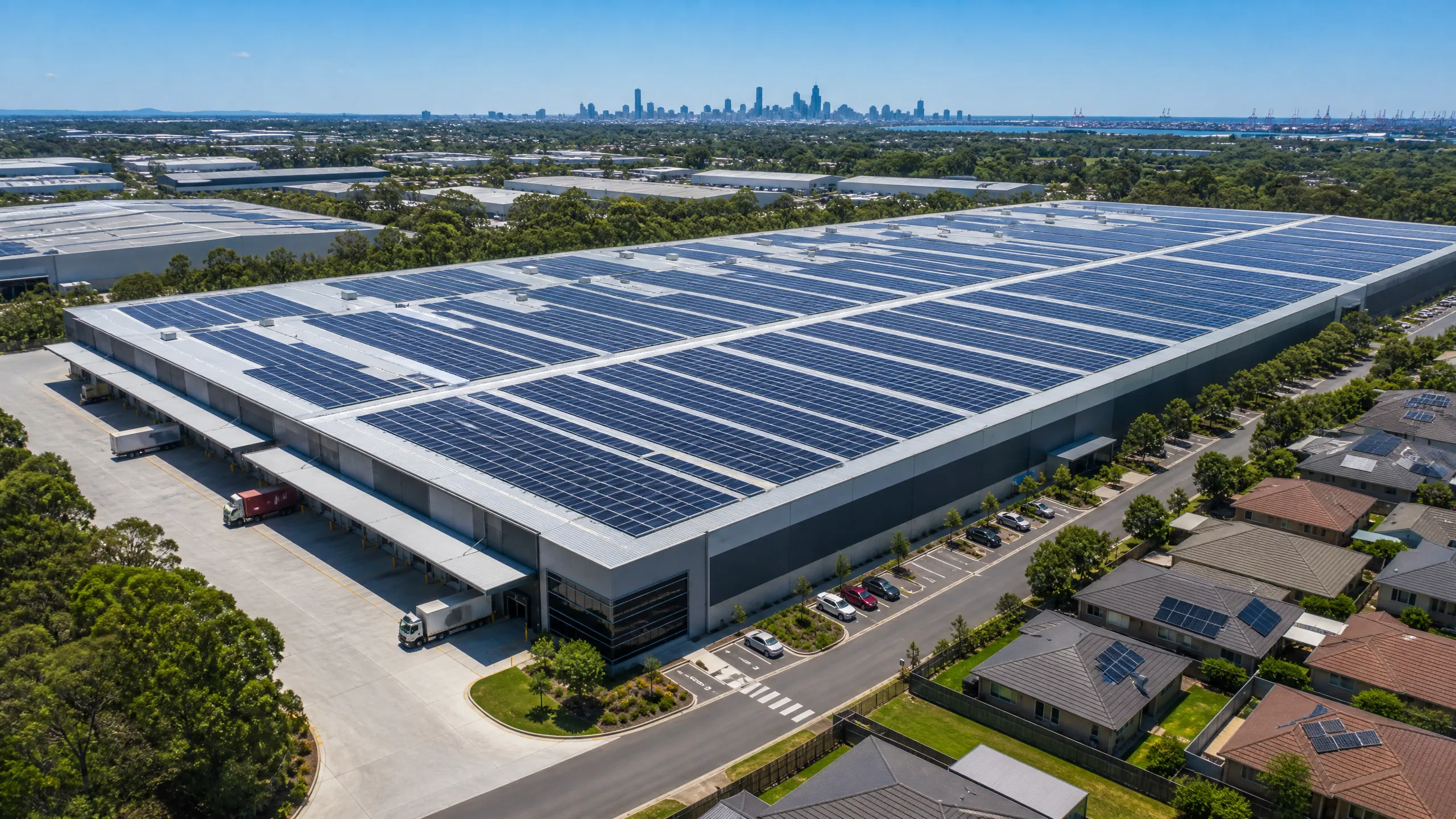
That is about to change.
On 5 August, the Australian Government announced an expansion of the Small-scale Renewable Energy Scheme (SRES). The scheme currently provides upfront discounts through tradeable certificates for eligible systems up to 100 kilowatts. The government intends to increase that limit to 1 megawatt, or 1,000 kilowatts.
The Clean Energy Regulator expects the changes to apply to mid-scale solar installed from 1 October 2026, subject to the necessary regulations being in place.
Why a commercial solar change matters to households
If you are a homeowner, this announcement does not change the rebate for a typical residential system. Existing arrangements for systems below 100 kW remain unaffected.
But it does matter to you, for two reasons.
First, it targets the "missing middle": factories, warehouses, large farms, supermarkets, schools and hospitals. A 1-megawatt system is roughly ten times larger than the previous limit. The government estimates the expansion could reduce upfront installation costs for these commercial systems by around 20 per cent. By generating power exactly where heavy daytime energy is used, businesses can shield themselves from volatile global energy prices. That should theoretically help reduce costs across manufacturing, agriculture and retail.
Second, it helps the grid. The Australian Energy Market Operator’s latest Quarterly Energy Dynamics report showed that renewables reached a record 42.1 per cent of generation in the National Electricity Market in the June quarter. Rooftop solar and growing battery participation helped drive wholesale electricity prices to their lowest June-quarter average since 2020.
When a warehouse or factory generates its own power during the day, it reduces demand on the wider network. That takes pressure off the poles and wires that serve everyone else, smoothing out demand peaks and reducing the need for expensive grid upgrades that eventually find their way into household bills.
What else mattered this week
Data centres will be asked to bring their own power
The SRES expansion is not the only policy trying to manage large energy users. In a speech to the National Press Club on 5 August, the Minister for Climate Change and Energy outlined the government's proposed approach to large AI data centres.
Large AI data centres are huge, stable consumers of electricity. The government has proposed using the Renewable Electricity Guarantee of Origin scheme, through a national AI standard, to require them to prove their electricity use is matched with new, additional renewable energy. The proposed approach would also require adequate firmed power such as batteries or gas peaking to support grid stability.
This is a proposed policy, not a final rule, and more details are expected soon. But it shows why expanding commercial rooftop solar is so urgent: the grid needs to find capacity for massive new industrial loads without pushing up prices for ordinary consumers.
Origin Energy customer data incident
Origin Energy continues to investigate a data security incident that it believes involved the information of approximately 900,000 current and former customers. The company says impacted data may include names, addresses, dates of birth, phone numbers, account details, and partial credit card or bank account numbers.
If you are an Origin customer, the practical advice is straightforward. Be highly cautious of unexpected calls, emails or texts claiming to be from Origin or your bank. Do not click links in unsolicited messages. Independently verify the identity of any caller by using official contact numbers. Origin recommends resetting your My Account password, changing it elsewhere if you reuse it, and using two-step authentication where available.
System Health Diagnostic Corner: The five-minute sunny-day comparison
This week, we are looking at the simplest way to check whether your solar system is performing normally. Australian Government guidance recommends using monitoring data to look for generation that is lower than usual on sunny days.
The amount of electricity your system generates changes every day based on the season, the weather and the angle of the sun. You cannot compare a rainy Tuesday in August with a clear Saturday in January.
But you can compare two similar days.
The Check | How to do it | Why it matters |
Find a clear day | Open your monitoring app and look at the generation curve for yesterday, provided it was sunny and cloudless from morning to afternoon. | You need a baseline of what the system can produce when conditions are good. |
Compare it to a similar day | Look back in your app history to a similarly clear, sunny day from exactly one or two weeks ago. | Comparing days close together in the same season removes the effect of the sun's changing angle. |
Look for the peak | Did both days reach roughly the same peak generation in the middle of the day? | A sudden, unexplained drop in peak generation on a perfectly clear day can point to a fault or a new shading problem. |
If the numbers are significantly different and you cannot explain why—such as a tree branch you have not cut, or heavy smoke in the air—make a note of it. Check again on the next clear day. If the drop persists, contact your installer, retailer or a qualified solar professional.
Do not attempt to inspect the panels on your roof or open the inverter casing. Your job is to use the data; a professional's job is to diagnose the hardware.
Get the next issue in your inbox.
One email a week. Written by someone who works inside the industry.
You might also like
Australia Has Now Installed 100 Community Batteries. Here’s Why That Matters Even If You Don’t Own One.
Australia has now installed its 100th community battery under the Australian Renewable Energy Agency’s Community Batteries Funding Initiative. That is a small number compared with the hundreds of thousands of batteries being installed in homes, but it marks an important shift in the way rooftop solar is starting to work.
Your Solar System Is Becoming Part of the Grid. South Australia Just Tested That.
It is easy to think of rooftop solar as a private appliance. Panels make electricity. Your home uses it. Anything left over goes to the grid.
Half a Million Home Batteries Is a Milestone. The Hard Part Is Making Them Work Together.
Before we get into the news, a quick note. Watts Weekly missed its usual Wednesday edition last week. Rather than publish two thin posts or pretend nothing happened, this is one combined catch-up covering the two weeks from 3 to 16 August.