Your Solar System Is Becoming Part of the Grid. South Australia Just Tested That.
It is easy to think of rooftop solar as a private appliance. Panels make electricity. Your home uses it. Anything left over goes to the grid.
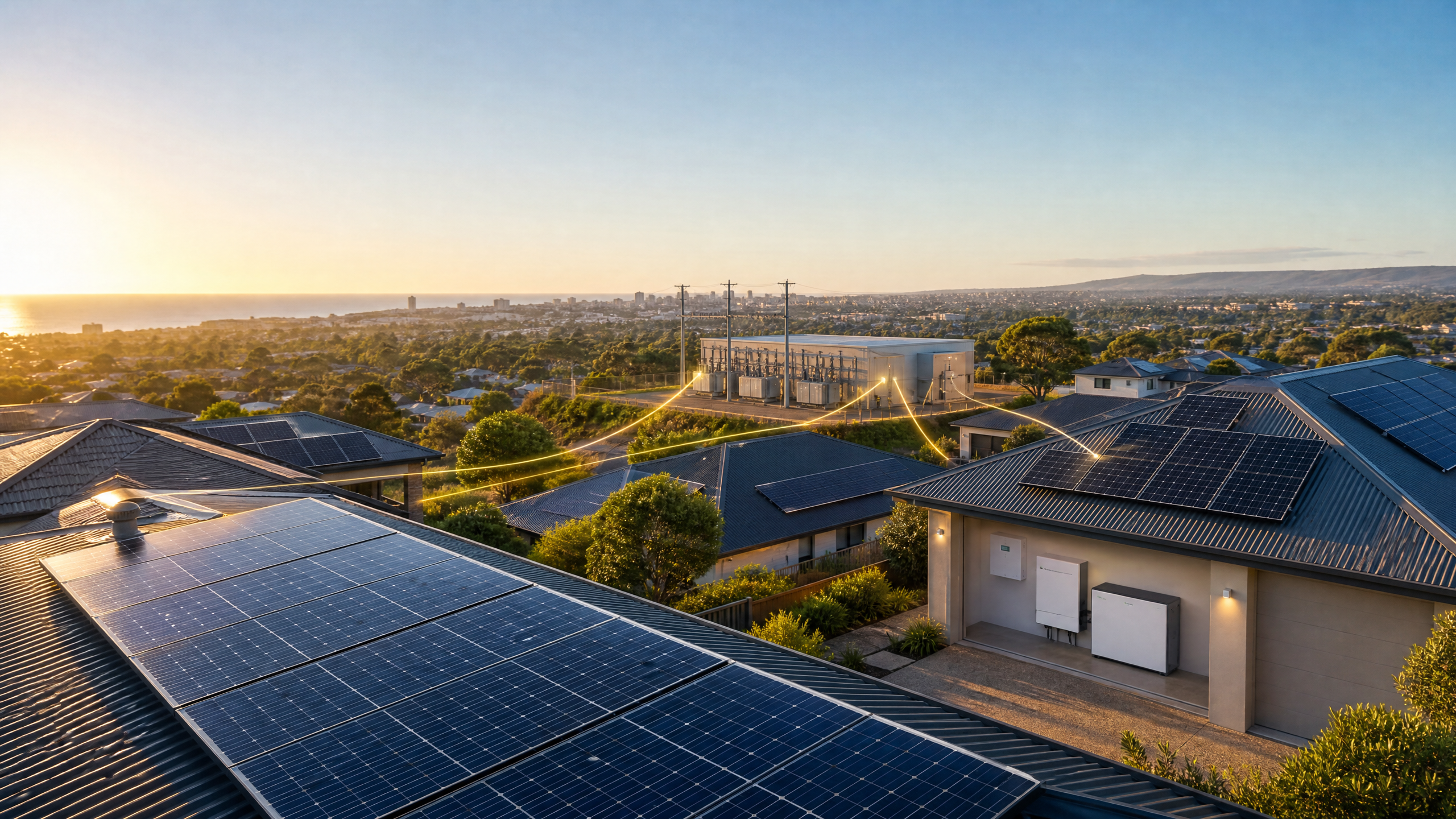
That model is no longer quite right.
On 25 August, SA Power Networks ran its annual Smarter Homes solar-curtailment preparedness test. Around 100,000 South Australian customers with eligible systems could have seen their rooftop solar ramp down to 0 kW and then return, for less than an hour. The network expected an average impact of about 1.5 kWh of generation per participating customer. That sounds unsettling until you understand what it is for.
This is not a routine plan to switch off household solar, nor does it mean your system has failed. It is a once-a-year “fire drill” for a rare electricity-system security emergency. SA Power Networks says it may be directed by the Australian Energy Market Operator to use this capability if the system needs protection at very short notice. The test checks that systems installed after September 2020 are compliant, that the relevant third parties can respond quickly, and that systems reconnect smoothly afterwards.
The bigger point is that rooftop solar is no longer just on the edge of the electricity system. It is becoming part of how that system is run.
Why would a grid need to slow down solar?
South Australia has some of the highest rates of rooftop solar in the world. On mild, sunny days, household panels can produce so much electricity that demand supplied by the traditional grid becomes very low.
That is good news in many ways. It means less fuel is burned and households have more ability to generate their own energy. But a power system still needs enough large, controllable equipment operating to maintain voltage, frequency and stability. If traditional demand falls too far while rooftop generation remains high, the system can become harder to manage safely.
The answer is not “stop installing solar.” It is to make solar smarter, pair it with batteries and flexible demand, improve visibility on local networks, and ensure systems can respond in genuinely rare emergencies.
South Australia has been dealing with this reality earlier than most places. The rest of Australia is heading in the same direction.
What affected customers should do
SA Power Networks told customers that the test would be complete by sunset and that most people would not notice it. It advised anyone who wanted reassurance to check the inverter screen or monitoring app the next day, 26 August. If the system had not returned to normal, the first contacts should be the installer or inverter manufacturer.
That advice is useful well beyond South Australia. A monitoring app is not just there to show how much solar you made last month. It is your simplest way to check whether the system is online, generating and behaving as expected.
Situation | What it may mean | Safe next step |
Your app showed solar generation briefly fall to zero on 25 August, then recover | If you were part of the South Australian test, that may have been the planned curtailment. | Check whether normal generation returned on the next clear day. |
Your app or inverter is still offline | It may be a communications, inverter or broader system problem; it is not something to diagnose from the roof. | Note any fault code and contact the installer, retailer or inverter manufacturer. |
Solar output is lower than usual on comparable sunny days | Weather, shade, soiling, a fault or a configuration issue could be involved. | Compare two similar clear days, then ask a qualified professional for advice if the pattern persists. |
Do not open electrical equipment, climb onto the roof, or change export and inverter settings because of a news story. Your job is to observe the data. A qualified professional’s job is to diagnose the hardware.
Batteries are changing the market, but not solving everything
The curtailment test arrived during a month of major battery and market news.
On 20 August, the Australian Energy Regulator released its latest wholesale electricity market performance report. It found wholesale prices fell in every National Electricity Market region during 2025, helped by fewer extreme price events and expanding wind, solar and battery supply. Installed battery capacity rose from 2.2 GW to 6.1 GW during the year.
The report also contains the important caveat that gets lost in many headlines: wholesale prices do not flow through to household bills immediately or dollar-for-dollar. Network charges, supply charges, retailer costs and the tariff you are on still matter.
“Batteries alone will not resolve every pressure in the market.” — Australian Energy Regulator.
The regulator’s point is exactly right. Batteries are increasingly useful during evening peaks, when solar output has fallen, and demand remains high. But the transition also needs transmission, local-network upgrades, flexible electricity use and well-designed tariffs.
For households, that means the value of a battery should be assessed against your own usage pattern and plan—not just a national headline about lower wholesale prices.
The month so far: more batteries, bigger commercial rooftops
Two earlier August developments are worth carrying into this catch-up.
First, the Federal Government announced on 14 August that more than 500,000 Cheaper Home Batteries had been installed under its program. The government said more than three quarters were in outer suburban and regional communities, and that the number of accredited battery installers had doubled to 8,846 since the program began.
That is a major scaling story. It is also why monitoring, commissioning and after-sales support are becoming more important. A battery that is installed but not communicating, poorly configured or not operating as expected is not giving its owner the value they bought it for.
Second, the Government announced its intention to expand Small-scale Renewable Energy Scheme eligibility from 100 kW to 1 MW for mid-scale solar systems. The change is aimed at commercial, industrial, agricultural and community roofs, not typical homes. The Clean Energy Regulator expects it to apply from 1 October 2026, subject to regulations and further requirements. Existing arrangements below 100 kW remain unaffected.
This is the “missing middle” of Australian solar: factories, warehouses, farms, schools and hospitals that use large amounts of electricity during the day. If more of those sites generate and use solar locally, the grid has a better chance of handling both growing demand and growing rooftop generation.
System Health Diagnostic Corner: three checks after a grid event
Australian Government guidance says most solar monitoring systems can show whether your system is generating as expected, while battery monitoring can show whether it is charging and discharging regularly.
This week, take three minutes to check:
-
Is the system online? Open the app or look at the inverter display. An unexpectedly blank or disconnected system is worth following up.
-
Is solar generation plausible? Compare the output from two broadly similar, clear days. Do not compare a winter cloudy day with a summer clear day.
-
If you have a battery, is it showing normal activity? Observe whether it charges and discharges as your system is configured to do. Do not change settings unless you understand the consequences or have qualified advice.
This is not a substitute for a professional inspection. It is basic ownership hygiene. The faster you notice that something is unusual, the easier it is to explain the problem to an installer, manufacturer or retailer.
The real late-August story
The South Australian test is a small event with a big meaning.
The early phase of rooftop solar was about installation: put panels on roofs, reduce daytime purchases from the grid and export what is left.
The next phase is about coordination. Systems need to be visible enough to operate safely, batteries need to be used intelligently, households need tariffs that reward flexibility without hiding costs elsewhere, and networks need to treat customer energy assets as part of the system rather than an afterthought.
That is more complicated than the old solar story. It is also more valuable.
Get the next issue in your inbox.
One email a week. Written by someone who works inside the industry.
You might also like
Australia’s Solar Support Now Reaches 1 MW. What Changes on 1 October.
Australia has expanded federal support for larger rooftop and on-site solar projects.
Australia Has Now Installed 100 Community Batteries. Here’s Why That Matters Even If You Don’t Own One.
Australia has now installed its 100th community battery under the Australian Renewable Energy Agency’s Community Batteries Funding Initiative. That is a small number compared with the hundreds of thousands of batteries being installed in homes, but it marks an important shift in the way rooftop solar is starting to work.
Half a Million Home Batteries Is a Milestone. The Hard Part Is Making Them Work Together.
Before we get into the news, a quick note. Watts Weekly missed its usual Wednesday edition last week. Rather than publish two thin posts or pretend nothing happened, this is one combined catch-up covering the two weeks from 3 to 16 August.