Half a Million Home Batteries Is a Milestone. The Hard Part Is Making Them Work Together.
Before we get into the news, a quick note. Watts Weekly missed its usual Wednesday edition last week. Rather than publish two thin posts or pretend nothing happened, this is one combined catch-up covering the two weeks from 3 to 16 August.
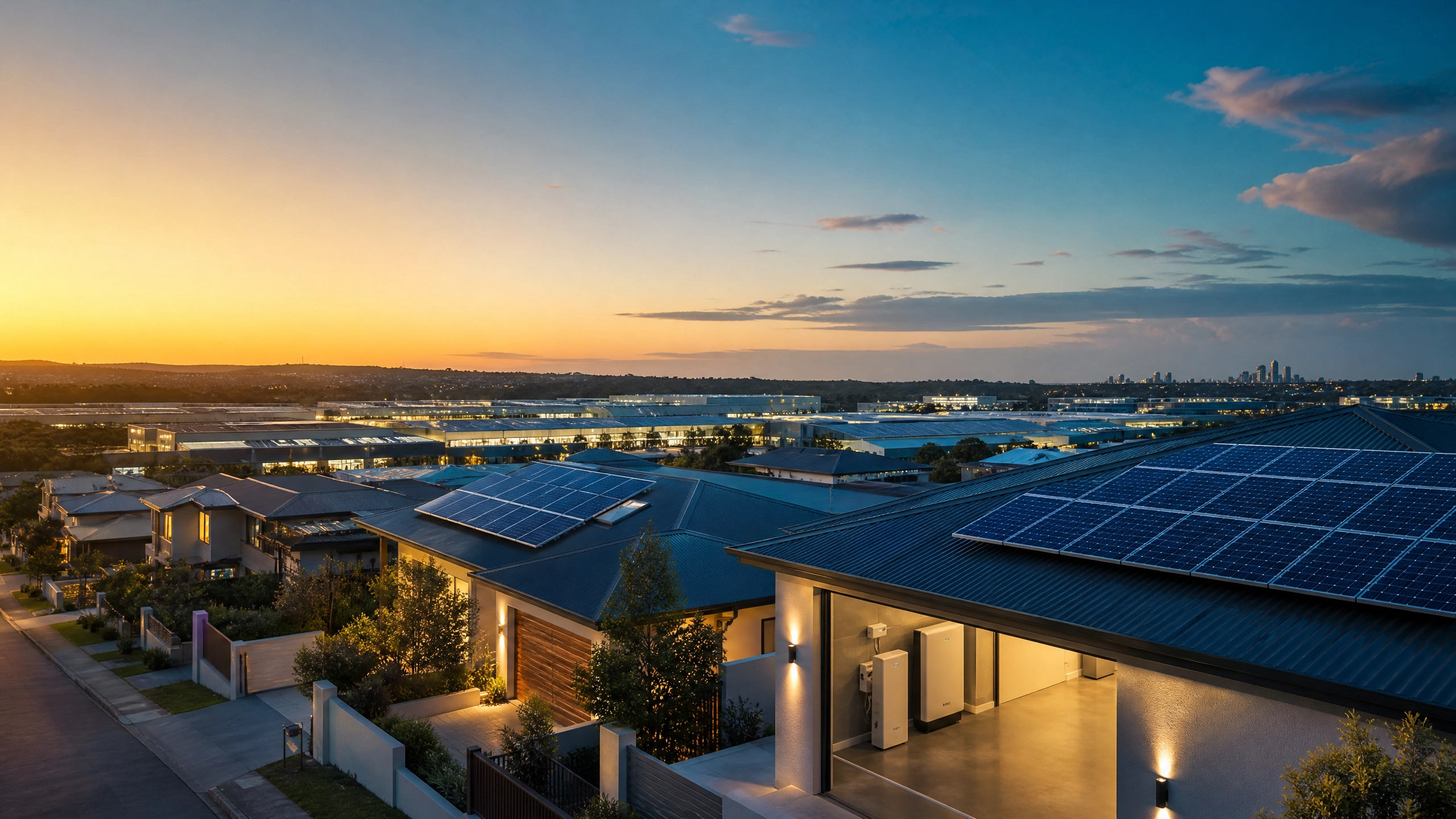
The short version is this: Australia’s solar story is moving beyond simply putting panels on roofs. We have now crossed half a million subsidised home batteries, the federal government is preparing to open a new pathway for much larger commercial rooftops, and the grid is being reshaped by solar and storage faster than the old rules were designed for.
The next phase is not only about buying more hardware. It is about making solar, batteries, tariffs, local networks and large new electricity users work together.
Half a million home batteries: the second act of rooftop solar
On 14 August, the Federal Government announced that more than 500,000 Cheaper Home Batteries had been installed under its program. It also said more than three quarters of those installations were in outer suburban and regional communities, and that the number of accredited battery installers had doubled to 8,846 since the program began.
That is a meaningful milestone. Australia has long been a world leader in rooftop solar. A battery changes what that solar can do. Instead of exporting everything not used in the middle of the day, a household can store some of it for the evening, when demand and grid prices are often higher.
But a battery is not a magic bill-reduction box. Its value depends on your solar output, electricity tariff, household load, backup expectations, battery settings and whether you choose to participate in a virtual power plant. The government says the growing battery fleet is reducing the evening peak and putting downward pressure on bills across the grid. That is a system-level claim, not a promise that every household will achieve the same result.
The important change is behavioural. Solar owners are becoming energy managers. The question is no longer only, “How many panels do I have?” It is increasingly, “When do I use power, when do I store it, and how do I know the system is doing what I paid for?”
Australia’s next big solar rebate is not for houses
The other major policy development of the fortnight is aimed at the roofs above the places we work.
On 5 August, the government announced its intention to expand the Small-scale Renewable Energy Scheme from 100 kilowatts to 1 megawatt for mid-scale solar systems. The change is designed for factories, warehouses, farms, schools, hospitals and community facilities. It is expected to apply to systems installed from 1 October 2026, subject to regulations and further design, installation and compliance requirements.
This does not change the household solar rebate. Existing arrangements for systems below 100 kW are unaffected.
It still matters to households. Commercial and industrial buildings often use most of their energy during the day, exactly when solar is strongest. More generation on these roofs can reduce demand on the wider network and help avoid some expensive grid upgrades.
The policy is trying to address Australia’s solar “missing middle.” The Institute for Energy Economics and Financial Analysis estimates that households have about 22 GW of solar capacity on their roofs, while commercial and industrial premises have about 5.6 GW. These are capacity figures, not counts of roofs or businesses.
The commercial opportunity is large, but it is not simple. Business projects face complicated network connection processes, varied demand tariffs, landlord-tenant split incentives and capital-allocation hurdles. The new scheme can help, but it will not remove all of those obstacles.
The grid is already behaving differently
This policy momentum is happening because Australia’s electricity system is changing in real time.
Australian Energy Market Operator’s latest Quarterly Energy Dynamics update found that renewables supplied a record 42.1% of National Electricity Market generation in the June quarter. It also reported 3,283 MWh of additional household-battery capacity in the NEM during the quarter, a 41% increase, while grid-scale battery capacity more than doubled over the past year to exceed 9 GW. Record renewable output and growing battery participation coincided with the lowest June-quarter wholesale-price average since 2020.
That does not mean every household bill automatically falls. Wholesale prices are only one component of a retail bill, alongside network costs, supply charges, retailer margins and your own tariff. But it does show why batteries and flexible demand matter. They help move energy from the solar-rich middle of the day into the evening, when the grid needs it more.
It also explains why product quality, commissioning and monitoring matter more than they did in the early solar boom. A system that is technically installed but poorly configured, disconnected from its app or unable to respond as designed is not delivering its full value to its owner or to the grid.
The next pressure point: large AI data centres
The government is also thinking ahead to a different sort of electricity user: large AI data centres.
In a 5 August speech, the Energy Minister outlined a proposed national approach that would require large AI data centres to demonstrate that their electricity use is matched with new, additional renewable energy and adequate firming. The approach would use the Renewable Electricity Guarantee of Origin scheme and a national AI standard. More detail is expected, so this should not be treated as a final rule.
The principle is worth watching. If large new electricity users bring their own generation, storage and flexibility, they can support investment without simply pushing costs onto households. If they do not, they risk competing with everyone else for scarce grid capacity.
System Health Diagnostic Corner: the two-day battery check
This week, do not change any settings. Just observe your battery.
Australian Government guidance says a battery monitoring system should show whether the battery is charging and discharging regularly.
What to check | What you are looking for | What to do next |
A sunny afternoon | Is the battery charging while your solar system is generating more than the house is using? | Take a screenshot or note the time and state of charge. |
After sunset | Is the battery discharging to support household use, assuming that is how your system is configured? | Compare it with your evening consumption and tariff. |
The next similar day | Does the basic pattern repeat, or does the app show a fault, unexplained flat line or unexpected behaviour? | If something persists, contact your installer, retailer or a qualified solar professional. |
Your monitoring app will not diagnose every fault. But it gives you a starting point. Never open electrical equipment or attempt your own repairs.
What the fortnight tells us
The energy transition is becoming more personal and more complicated at the same time.
Australia’s solar success is no longer only measured by how many panels are installed. It is measured by whether households can use their systems confidently, whether batteries are appropriately sized and monitored, whether business rooftops can finally join the transition at scale, and whether the grid can absorb all of this new capability without passing avoidable costs on to consumers.
Half a million batteries is a remarkable milestone. The next milestone will be less visible: millions of households and businesses using their energy assets well.
Get the next issue in your inbox.
One email a week. Written by someone who works inside the industry.
You might also like
Australia’s Solar Support Now Reaches 1 MW. What Changes on 1 October.
Australia has expanded federal support for larger rooftop and on-site solar projects.
Australia Has Now Installed 100 Community Batteries. Here’s Why That Matters Even If You Don’t Own One.
Australia has now installed its 100th community battery under the Australian Renewable Energy Agency’s Community Batteries Funding Initiative. That is a small number compared with the hundreds of thousands of batteries being installed in homes, but it marks an important shift in the way rooftop solar is starting to work.
Your Solar System Is Becoming Part of the Grid. South Australia Just Tested That.
It is easy to think of rooftop solar as a private appliance. Panels make electricity. Your home uses it. Anything left over goes to the grid.