The Regulator Is Checking Solar Systems. Here’s What You Should Check Too
This week, Australia’s Clean Energy Regulator made an announcement that sounds like industry paperwork, but it should matter to every solar and battery owner.
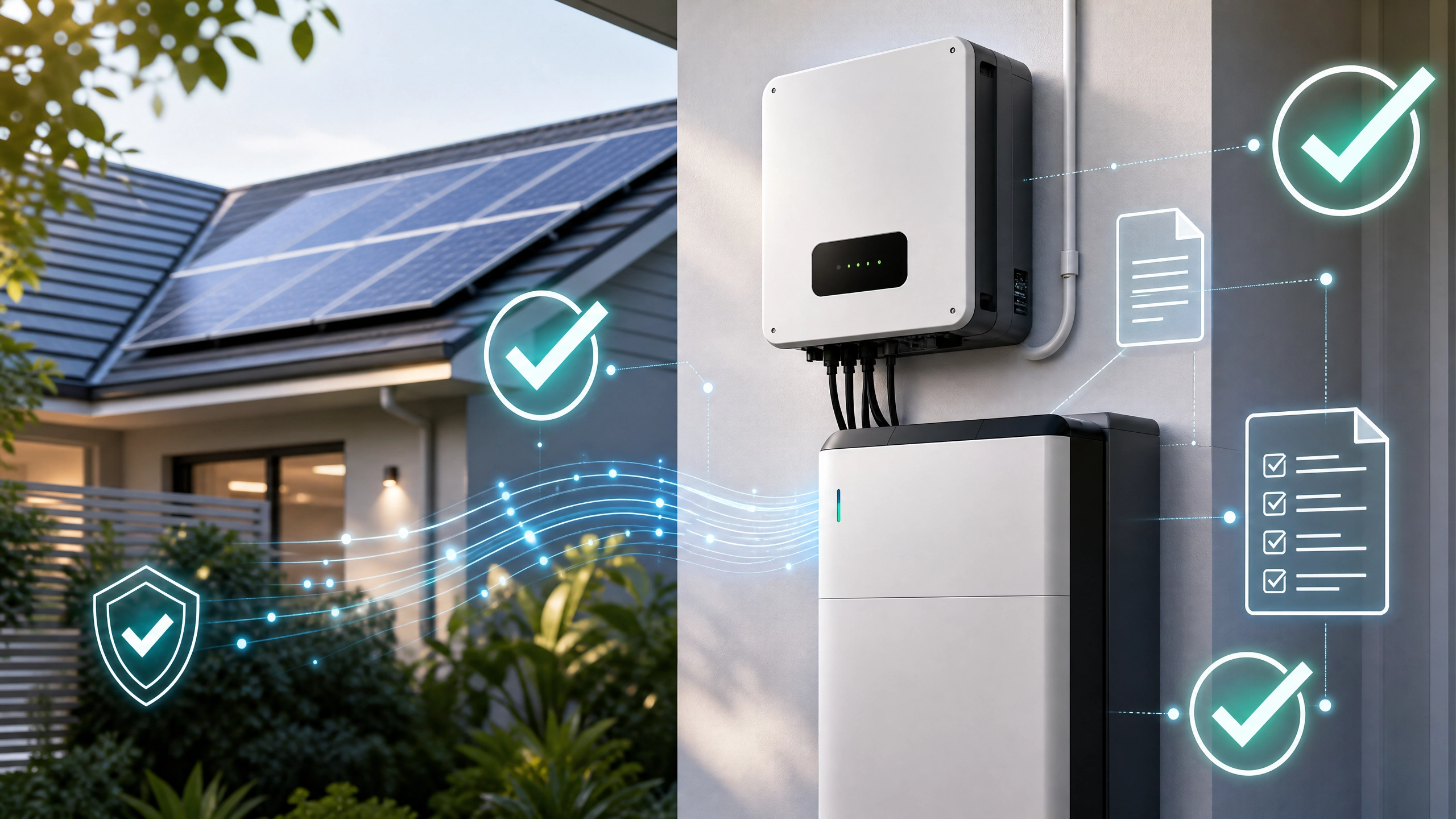
The regulator has begun using an AI-assisted image-analysis tool to help check whether battery-installation photos show the labels they are supposed to show, and whether the images carry the required metadata. Its officers, not the AI, make the final compliance decision.
At the same time, the regulator disclosed a series of enforcement actions. It permanently suspended 21 companies that had previously operated in the Small-scale Renewable Energy Scheme because they had been deregistered by ASIC and were no longer legal persons meeting the scheme’s fit-and-proper-person rules. That does not mean every one of those companies was suspended because of a dangerous installation. The distinction matters.
But the wider update also included a more direct warning for consumers. The regulator has issued a notice of intention to stop a separate solar retailer from making the written statements needed to support small-scale technology certificate claims, following preliminary findings that systems had been declared complete and capable of generating electricity when they were not.
There is a simple lesson here: a solar or battery system is not healthy merely because it is installed, switched on, or showing a number on an app.
A genuinely healthy system has four things working together: the equipment, the monitoring, the paperwork and the people responsible for it.
A new kind of quality check
For years, buying solar was often treated as a one-off transaction. Get a few quotes. Pick a panel and inverter. Sign the paperwork. Wait for the installation. Move on.
That model is becoming inadequate.
Australia now has millions of rooftop systems, more batteries are being added every month, and customers are being asked to make decisions about tariffs, virtual power plants, smart meters, backup power and electric-vehicle charging. The technology is more valuable, but the ownership experience is also more complicated.
The regulator’s new photo requirements are a small but important sign of that shift. Since 1 March, solar battery installations claiming support under the scheme have required clear, geotagged and timestamped photos of critical labels, in addition to existing on-site verification photos. The regulator says its tool helps its officers identify missing labels or metadata issues faster.
It may sound administrative. It is not.
Labels, commissioning records, serial numbers and electrical certificates are the paper trail that helps establish what was installed, whether it met the program’s conditions, and who should be contacted if a problem emerges. If that information is missing when you need warranty support, technical help or a professional inspection, the system can become much harder to manage.
The same is true of monitoring. A solar system can still produce some electricity while a fault, shading issue, inverter problem, incorrect setting or battery issue quietly erodes its value. The Australian Government advises owners to use their monitoring system, look for lower-than-usual generation on sunny days, and seek qualified help if the system is not working as expected.
That is why Watts Weekly is beginning a regular System Health feature. The purpose is not to tell everyone they need to buy a paid service every year. It is to help owners understand what they have, notice when something changes, keep the records that matter, and know when to call a qualified professional.
The compliance story is not only about installers
The industry should take the regulator’s action seriously. So should retailers, registered agents and anyone selling a system with an incentive attached.
The regulator has identified cases where on-site verification selfies did not accurately represent the accredited installer recorded for the installation. It has also declared one installer ineligible for 12 months following findings across 10 systems involving licensing, safety certificates, mandatory standards and false or misleading statements.
For homeowners, the takeaway is not to assume wrongdoing. It is to ask ordinary, sensible questions before and after installation.
Ask or check | Why it matters |
Who is the legal entity on my quote, contract and invoice? | A trading name is not the same thing as the company that sold you the system. |
Who is the accredited installer, and who actually attended site? | Accreditation and battery endorsements are relevant to eligibility and technical accountability. |
Where are my commissioning documents, electrical certificates and equipment serial numbers? | You may need them for warranty, insurer, retailer, manufacturer or servicing conversations. |
Can I access my monitoring app today? | Monitoring is often the earliest way to notice a performance or battery issue. |
What does my warranty cover, and who is my first contact if something fails? | A manufacturer warranty, retailer warranty and workmanship warranty can have different pathways. |
None of this replaces a licensed electrician or accredited solar professional. Do not open electrical equipment, climb onto a roof, or attempt a repair yourself. But knowing what paperwork exists and whether your monitoring is alive is basic ownership.
What else mattered this week
$30 million for a smarter grid
The federal government announced $30 million in Grid Enhancing Technologies grants for 14 projects across Australia. The projects include vehicle-to-grid trials, incentives for smarter EV charging, tools to help renewable projects find connection points, technology to keep the grid stable during high solar generation, and shared solar-and-battery optimisation for multi-unit dwellings.
This matters because more household solar and batteries do not automatically create a better energy system. The poles, wires, tariffs and software have to catch up. The useful question is increasingly not only, “Can my home generate power?” but also, “Can the local grid use that power intelligently?”
A reminder on the federal battery discount
The Cheaper Home Batteries Program can reduce the upfront price of an eligible battery through small-scale technology certificates. But eligibility is not a shopping list.
Under the current rules, an eligible battery must be new, connected to new or existing solar of no more than 100 kW, and have a nominal capacity between 5 and 100 kWh. Certificates can be claimed only for the first 50 kWh of usable capacity. Grid-connected batteries must be technically capable of joining a virtual power plant, although that capability does not mean you are automatically enrolled in one.
The right battery is not necessarily the largest one that attracts a discount. It is the one designed around your household use, tariff, backup expectations, likely future loads and the way you actually want to live with the system.
System Health Diagnostic Corner: the five-minute handover check
This week, do not inspect equipment. Inspect your information.
Open a folder, a cloud drive or the drawer where you keep household records. Can you find these five things?
Item | What “good” looks like |
Monitoring access | You can sign in to the inverter or battery app and see current or recent data. |
System inventory | You have the panel, inverter and battery makes, models and serial numbers. |
Commissioning and electrical records | You can locate the documents issued when the system was installed. |
Warranty information | You know the manufacturer, workmanship and installation-warranty terms. |
A real contact path | You have the legal company name, phone number, email and installation date. |
If one of these is missing, make a note now rather than waiting for an inverter fault, a warranty claim or a house sale. The first step in looking after a solar asset is being able to identify it.
Australia’s energy system is getting smarter, more decentralised and more regulated. The households that get the most value will not simply be the ones that buy the newest hardware. They will be the ones that understand the system they already own, keep its records intact and treat it as the long-term household asset it is.
Get the next issue in your inbox.
One email a week. Written by someone who works inside the industry.
You might also like
Australia Has Now Installed 100 Community Batteries. Here’s Why That Matters Even If You Don’t Own One.
Australia has now installed its 100th community battery under the Australian Renewable Energy Agency’s Community Batteries Funding Initiative. That is a small number compared with the hundreds of thousands of batteries being installed in homes, but it marks an important shift in the way rooftop solar is starting to work.
Your Solar System Is Becoming Part of the Grid. South Australia Just Tested That.
It is easy to think of rooftop solar as a private appliance. Panels make electricity. Your home uses it. Anything left over goes to the grid.
Half a Million Home Batteries Is a Milestone. The Hard Part Is Making Them Work Together.
Before we get into the news, a quick note. Watts Weekly missed its usual Wednesday edition last week. Rather than publish two thin posts or pretend nothing happened, this is one combined catch-up covering the two weeks from 3 to 16 August.